
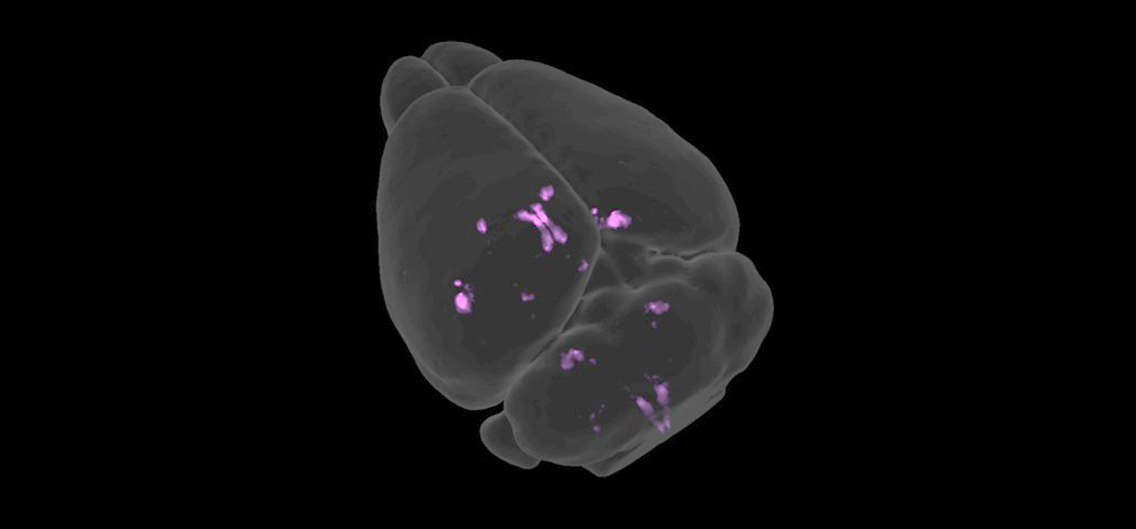
Mapping the Brain-Wide Response to Semaglutide using Whole-Brain c-Fos Imaging

Thomas Topilko
A single drug dose lights up dozens of brain circuits simultaneously. Here is what the semaglutide brain map tells us — and why this approach is changing preclinical CNS research.
LISTEN TO THE EPISODE
Map of the Month - May 2026
YouTube
A DRUG THAT BARELY NEEDS AN INTRODUSCTION
In the May 2026 edition of Vibraint's Map of the Month, we featured the brain-wide c-Fos response to semaglutide — the GLP-1 receptor agonist behind Ozempic and Wegovy. Few drugs in recent memory have transformed medicine as profoundly: semaglutide has redefined the treatment of type 2 diabetes and obesity, and its applications continue to expand.
But semaglutide is not simply a metabolic drug. It acts on the brain. And the whole-brain c-Fos map we generated makes that biology visible in a way no targeted experiment can — revealing not just where the drug acts, but which circuits it recruits, cascades down, and potentially engages as side effects.
This post explains the science behind the map: what c-Fos is, how we generate whole-brain activity maps using LS-Journey™, what the semaglutide data shows, and why this approach is becoming an essential tool in CNS drug discovery.
"What you're looking at is not just a simple drug effect, but a window into how a metabolic signal — one that normally starts in the gut after a meal — becomes a brain-wide response."
Thomas Topilko, Co-founder and CSO, Vibraint
WHAT IS C-FOS - AND WHY DO NEUROSCIENTISTS LOVE IT?
The origin story of c-Fos has nothing to do with neuroscience. In the 1960s and 70s, researchers studying a mouse virus that caused FBJ osteosarcoma — a specific bone cancer — identified the cancer-driving gene in that virus and called it v-Fos (for viral). They later discovered this viral gene had been derived from a normal cellular gene, creatively named c-Fos (for cellular fos).
At first c-Fos was studied as a proto-oncogene — a normal gene that, when misregulated, could drive cancer. Then, in the mid-1980s, something unexpected was discovered: c-Fos could be switched on within minutes after a cell received a strong signal. Researchers named it an immediate early gene, or rapid response gene.
Neuroscientists quickly realised the implications. Neurons do the same thing. After certain neurons become active, they switch on c-Fos — and the c-Fos protein appears in the nucleus of that neuron, acting almost like a flag: I was recently active.
WHAT DOES WHOLE-BRAIN C-FOS TELL YOU
A MOLECULAR SNAPSHOT OF RECENT BRAIN ACTIVITY
- c-Fos protein appears in neuronal nuclei 1–2 hours after activation
- Detects activation by drugs, behaviours, pain, stress, and sensory stimuli
- Captures the entire brain — not just the regions you decided to look at
- identifies primary target circuits AND unexpected downstream responders
- Quantifiable with AI-assisted image analysis across all 1,000+ brain regions
c-Fos has been used in thousands of published studies to map brain activity linked to stress, pain, hunger, sleep, reward, and social behaviour. What has changed recently — and what makes Vibraint's LS-Journey™ service fundamentally different from the conventional approach — is the ability to detect c-Fos across the entire brain in one shot, rather than in a handful of pre-selected sections.
THE POWER AND LIMITATIONS OF C-FOS
c-Fos is not a direct recording of neural firing. Understanding its capabilities and constraints is essential for designing studies that generate actionable data.
STRENGTHS
- c-Fos protein appears in neuronal nuclei 1–2 hours after activation
- Detects activation by drugs, behaviours, pain, stress, and sensory stimuli
- Captures the entire brain — not just the regions you decided to look at
- identifies primary target circuits AND unexpected downstream responders
- Quantifiable with AI-assisted image analysis across all 1,000+ brain regions
LIMITATIONS
- c-Fos protein appears in neuronal nuclei 1–2 hours after activation
- Detects activation by drugs, behaviours, pain, stress, and sensory stimuli
- Captures the entire brain — not just the regions you decided to look at
- identifies primary target circuits AND unexpected downstream responders
- Quantifiable with AI-assisted image analysis across all 1,000+ brain regions
The most important implication: c-Fos is a discovery and prioritisation tool, not an end point in itself. Used well, whole-brain c-Fos mapping narrows the hypothesis space from "something in the brain" to "these specific circuits, in these specific regions" — making every subsequent optogenetic, chemogenetic, or electrophysiological experiment more targeted and less likely to fail.
"What you're looking at is not just a simple drug effect, but a window into how a metabolic signal — one that normally starts in the gut after a meal — becomes a brain-wide response."
Thomas Topilko, Co-founder and CSO, Vibraint
HOW WHOLE-BRAIN C-FOS MAPS ARE MADE: THE LS-JOURNEY™ WORKFLOW
The technologies underlying whole-brain c-Fos mapping — tissue clearing and light sheet fluorescence microscopy — have existed in some form since the early 1900s. What made them impractical until recently was the absence of two supporting capabilities: computational infrastructure to store and process terabyte-scale imaging data, and AI tools to extract quantitative information from it reliably.
Vibraint's LS-Journey™ service integrates all of these components into a single managed pipeline.
01 C-FOS IMMUNOLABELLING
Fixed whole mouse brains are stained using validated antibodies against c-Fos protein. Antibody consistency across all animals in a study is critical — even small lot-to-lot variations can create apparent biological signal that is in reality artifactual.
02 IDISCO TISSUE CLEARING
The iDISCO protocol removes lipids through organic solvent delipidation, dehydrates the tissue, and immerses it in a refractive-index-matching solution. The result: a transparent, intact brain through which light passes with minimal scattering, while fluorescence from the antibody staining is fully preserved.
03 LIGHT SHEET MICROSCOPY AT 2-3UM
A thin sheet of laser light scans through the cleared brain volumetrically. Thousands of serial images are acquired and reconstructed into a complete 3D dataset — typically up to 1 terabyte of raw data per sample. A standard histology slice at 10 µm represents approximately 0.1% of the tissue block. Whole-brain light sheet imaging captures 100%.
04 AI-ASSISTED C-FOS CELL DETECTION AND COUNTING
Deep learning models detect every c-Fos-positive nucleus across the full 3D volume — unbiased, single-cell resolution quantification with no manual counting or region-by-region sampling bias.
05 BRAIN ATLAS REGISTRATION TO THE PERENS CCF
Each brain is registered to the Perens Common Coordinate Framework using tissue autofluorescence as an anatomical fingerprint. Every detected cell is mapped into this shared coordinate system, placing all animals across all treatment groups into the same anatomical space for direct statistical comparison. (Perens et al 2021, Neuroinformatics)
06 DATA DELIVERY IN CNS-VOYAGER™
3D brain maps, per-region cell density statistics, and group-level activity comparisons are delivered on Vibraint's CNS-Voyager™ virtual brain platform — fully interactive, shareable, and overlayable with connectivity, transcriptomics, and functional MRI data.
WHAT THE SEMAGLUTIDE MAP REVEALS
Semaglutide is a GLP-1 receptor agonist — it mimics glucagon-like peptide 1 (GLP-1), a hormone released by the gut after eating. GLP-1 receptors are expressed not only in the pancreas and gut, but in the brain. And the whole-brain c-Fos map following semaglutide administration makes the cerebral consequences of this biology unmistakable.
BRAIN STEM AND NAUSEA CIRCUITS
Robust activation appears in the caudal brainstem, including the nucleus tractus solitarius (NTS) and area postrema (AP) — regions that integrate visceral signals and are critically involved in nausea and emesis. This is consistent with the well-documented nausea reported by patients during semaglutide dose escalation, and illustrates how whole-brain c-Fos mapping can simultaneously identify efficacy circuits and potential side-effect-driving regions from a single experiment.
DOWNSTREAM NETWORK EFFECTS
Beyond the primary GLP-1 receptor-expressing cells, the map reveals activation in regions that are not direct receptor targets but are synaptically downstream — including the central nucleus of the amygdala (CEA) and parabrachial nucleus (PBN). These represent circuit-level propagation of the pharmacological signal, and their identification provides candidate regions for follow-up functional studies.
KEY INSIGHT
ANATOMY IS ARBITRARY; FUNCTION IS NOT
The atlas boundaries overlaid on a c-Fos map are, as Thomas Topilko notes, "artificial most of the time — similar to countries in geography." The biological signal respects functional organisation, not cartographic convenience. Whole-brain c-Fos maps can reveal functional units that span conventional atlas boundaries — a perspective impossible to gain from targeted section-based experiments.
FROM MAP TO MECHANISM - THE ROLE OF CNS-VOYAGER™
A brain-wide activity map answers the question: where does my drug act? But for drug discovery, the more important questions lie deeper: which cell types are active? Which circuits connect the primary responders to the rest of the brain? Does this activity pattern predict efficacy, toxicity, or side effects?
This is where Vibraint's CNS-Voyager™ platform becomes essential. Rather than delivering c-Fos maps as isolated images, CNS-Voyager™ places them within a navigable, multimodal framework — what Thomas Topilko describes as "a Google Maps of neuroscience."
CNS-VOYAGER™ DATA LAYERS
- Whole-brain connectivity atlases — identify which areas your activated regions project to and receive input from
- Spatial transcriptomics — determine which cell types are present in activated regions and whether they express the relevant receptors
- Functional MRI reference maps — compare your pharmacological c-Fos response to disease-state functional connectivity signatures
- Published neuronal activity datasets — contextualise your drug response against known activation patterns for appetite, pain, stress, and reward
For a GLP-1 agonist like semaglutide, this means separating the effects associated with appetite suppression from those associated with nausea — and potentially identifying circuit-level predictors of the nausea side effect that could guide next-generation compound design.
WHY THIS MATTERS FOR CNS DRUG DISCOVERY
The conventional preclinical workflow for CNS target engagement relies on pre-specified brain regions — meaning the experiment can only confirm or deny what the researcher already suspects. For a field where the likelihood of accidentally selecting the right region is, as Thomas Topilko puts it, "realistically quite low," this is a severe structural limitation.
Whole-brain c-Fos imaging inverts this logic. Start with an unbiased, brain-wide snapshot. Identify which regions respond. Then design targeted mechanistic follow-up studies for the circuits that actually matter — not the ones you hoped would matter.
For a senior neuroscientist or project manager working in biotech or pharma, the practical value is direct: faster hypothesis generation, lower probability of expensive late-stage failures, and richer mode-of-action data for regulatory submissions and partnership discussions.
"The goal is to move from this single-region obsession way of thinking to system-level interpretation."
Thomas Topilko, Co-founder and CSO, Vibraint
LISTEN TO THE FULL DISCUSSION
READY TO MAP YOUR COMPUND'S BRAIN WIDE SIGNATURE?
Talk to a Vibraint scientist about designing a whole-brain c-Fos imaging study for your programme — from first principles to delivered data on CNS-Voyager™