
WHAT DISCOVERIES WILL YOU MAKE AT THE FRONTIER OF NEUROSCIENCE
The frontier of science is where new discoveries are made. Ideas become breakthroughs and perseverance turns breakthroughs into new therapies. CNS-Voyager™ takes you to the frontier of neuroscience.
- Get access to more than 30,000 gene expression maps
- Explore the mouse brain in 3D and 2D
- Place stereotactic coordinates
- View your own whole-brain data once delivered via LS-Journey™
- 75% discount for PhD students
LISTEN TO THE PODCAST
CNS-Voyager™ - Google Earth for the mouse brain | Thomas Topilko
In this episode, Harry Salt is joined by Thomas Topilko, CSO and co-founder of Vibraint, to talk through CNS-Voyager™, Vibraint's virtual brain platform. The platform is designed around the shift in neuroscience from data generation to data interpretation.
40 min · Available on Spotify & YouTube

CSO at Vibraint
"We are working with leading scientists and pharma companies across the world to accelerate neuroscience"
-Jacob Hecksher-Sørensen, Vibraint CEO
WHAT IS CNS-VOYAGER™
CNS-Voyager™: an interactive virtual mouse brain, built from real imaging data
CNS-Voyager™ is a browser-based platform for exploring mouse brain biology in three dimensions. At its center is the Perens common coordinate framework (CCF) itself: a virtual brain built from whole-brain light sheet imaging across hundreds of individual animals, published as the peer-reviewed reference atlas by Vibraint co-founder and CTO Johanna Perens (Neuroinformatics, 2021).
Inside CNS-Voyager™, researchers navigate the brain anatomically, region by region, and layer in gene expression, cell population, and connectivity data on the same reference space. Data from a Vibraint LS-Journey™ study lands here natively.
WHY DID WE BUILD CNS-VOYAGER™
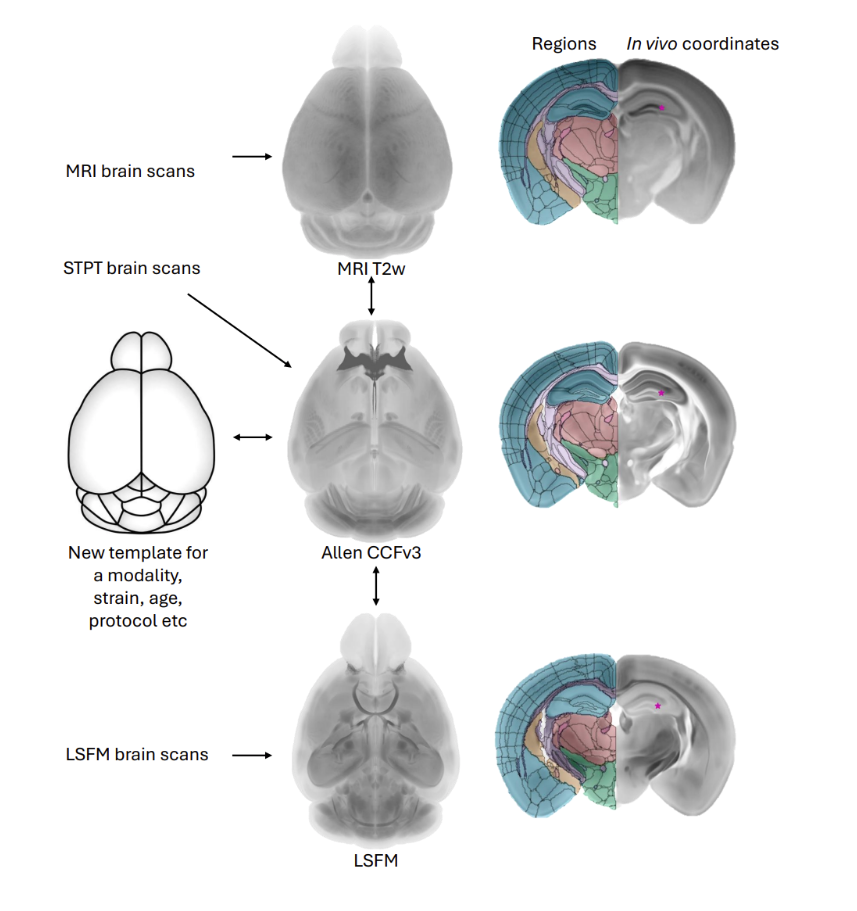
CNS-Voyager™ combines data from many different sources
Generating data is no longer a bottleneck. Atlases, whole-brain imaging, and molecular datasets are all more available than ever, and increasingly rich. What's still hard is pulling them into one place: each lives in its own format, its own coordinate space, its own silo, and combining them normally takes a specialist who knows how to register, align, and reconcile all three.
CNS-Voyager™ is our attempt to close that gap: one common space where anatomical, molecular, and connectivity data already live together, so the question a researcher is actually asking, which experiment to run next, doesn't get lost in the work of piecing the picture together first.
LOOK UP ANY GENE
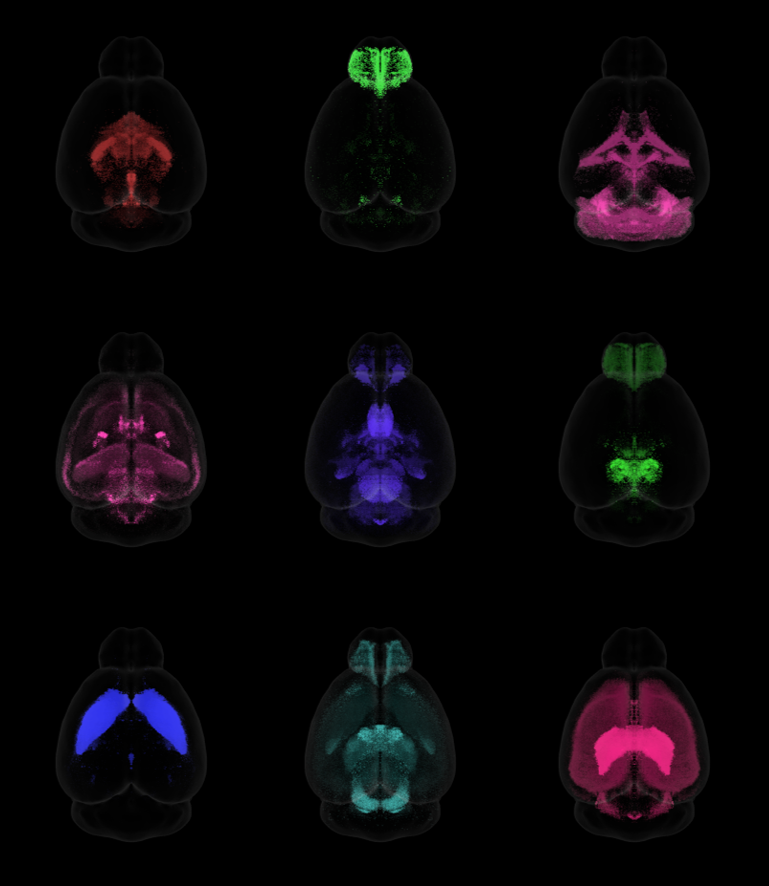
From spatial transcriptomics data to 3D interactive maps
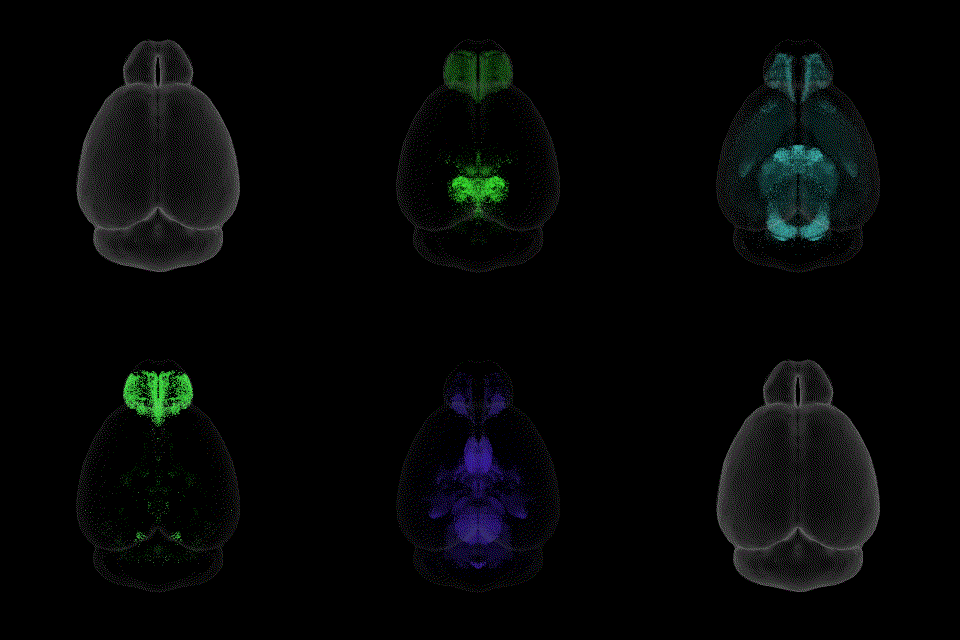
The biological starting point behind CNS-Voyager™'s maps is not continuous. It comes from serial sectioning: thin physical sections of the brain, imaged, and mapped back into three dimensions, producing millions of discrete single-cell observations, each with a location and a molecular identity. No two animals put their cells in exactly the same coordinates, so a map of individual cell positions wouldn't generalize from one brain to the next.
What is consistent, brain to brain, is the broader spatial pattern: where a given cell population tends to be dense, where it tends to be sparse. CNS-Voyager™ reconstructs that pattern computationally into a smooth, continuous, voxel-wise map across the whole brain. It's worth being precise about what that means: the map is not a literal microscope image where every colored point was directly measured at that exact spot. It's a reconstruction of the underlying biological pattern, built from millions of real cellular measurements. That distinction matters for how the data should be read, and we'd rather say it plainly than let anyone assume more precision than the method actually provides.

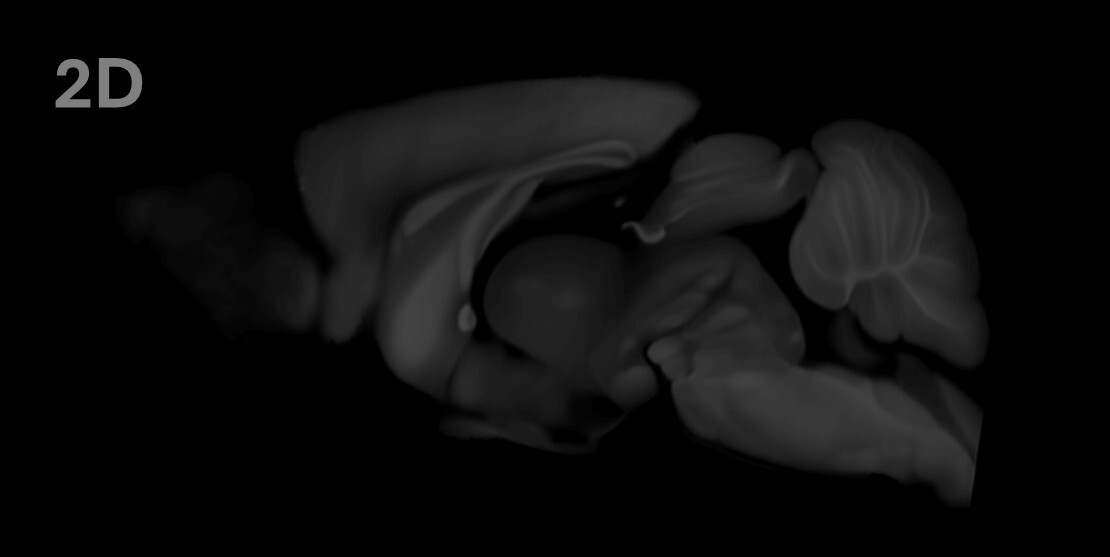
AN INTERACTIVE MOUSE BRAIN
EXPLORE THE ENTIRE BRAIN IN THREE DIMENSIONS
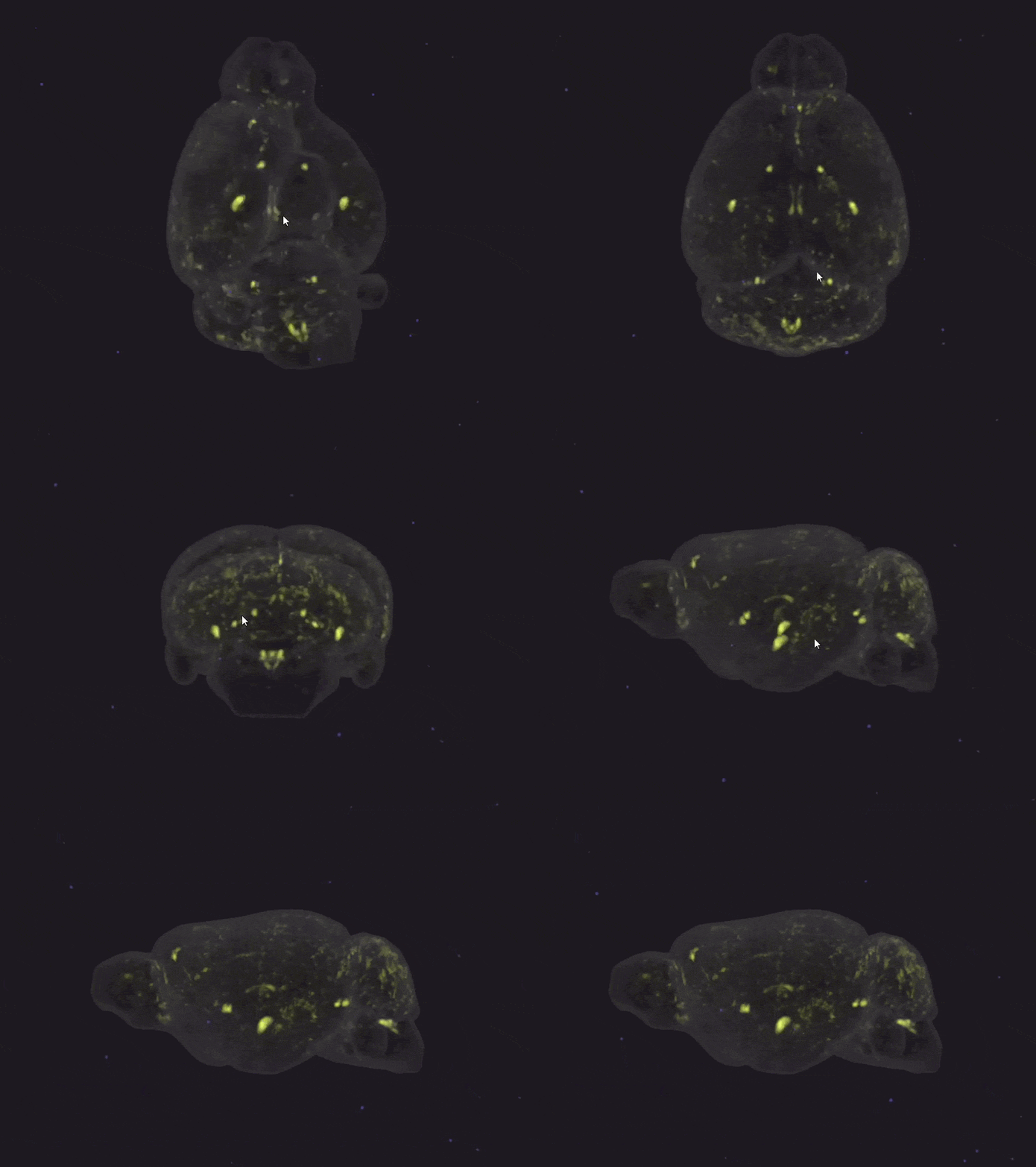
From day one, CNS-Voyager™ makes gene expression something you explore rather than something you look up. Zoom into any of 800+ anatomical regions, see where a gene or cell population is enriched, and move between whole-brain overviews and specific structures without leaving the reference space. Public datasets, including Allen Brain connectivity data and whole-genome expression maps from the ABC Atlas, sit on the same 3D canvas, so a researcher can ask a question once and see every layer of evidence that bears on it.
FOR ALL NEUROSCIENTISTS
MOVE DIRECTLY FROM RESULTS TO INSIGHT
A whole-brain screen has a way of being both a great result and a new problem at once. Say a feeding-behavior study shows fifteen brain regions responding to a hunger challenge. That's fifteen leads, and fifteen leads is often too many to chase blind. CNS-Voyager™ is built to help sort them: which of those regions are actually interconnected, which one looks like the input to the circuit, which looks like the output, and which relationship is worth the next experiment.
For a biotech or pharma team, the question usually starts from the other direction, a receptor already in hand. Is it expressed deep in the brain, where getting a molecule across the blood-brain barrier becomes the real constraint? Once a compound is in, which cells actually respond, the intended target population or something else entirely? CNS-Voyager™ won't answer either question for you. It's built to get you to the point where you can answer it yourself, faster.
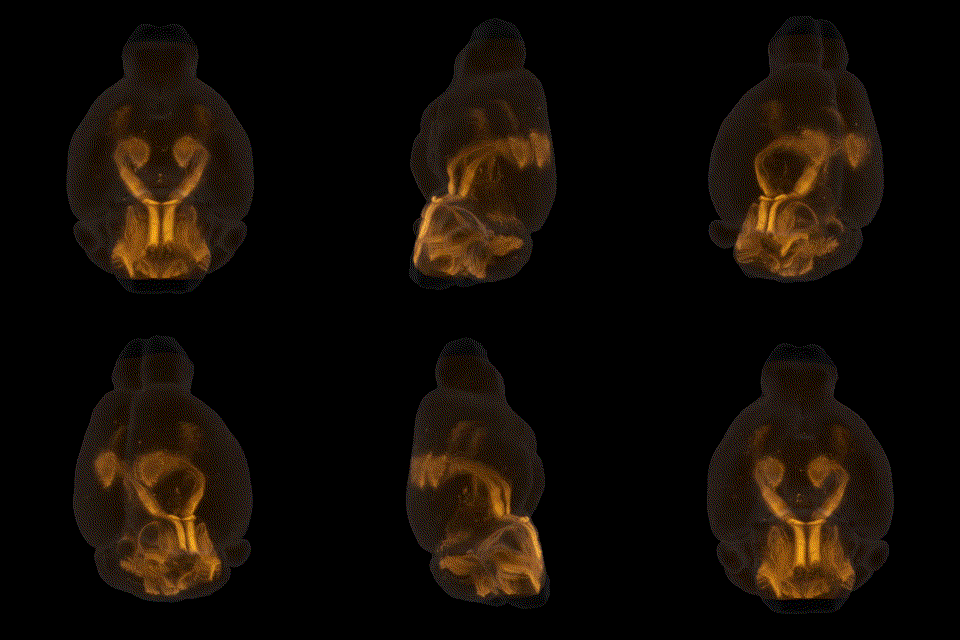
COMPATIBLE WITH LS-JOURNEY™
GET YOUR OWN WHOLE-BRAIN DATA DELIVERED IN CNS-VOYAGER™
Two paths lead into CNS-Voyager™. Run a whole-brain study through LS-Journey™, Vibraint's imaging and analysis service, and your results are native to the platform from the moment they're ready: your own private space, with the full CNS-Voyager™ library available to overlay alongside it. Every LS-Journey™ study includes 3 seats of CNS-Voyager™ access, free for 6 months, so the data doesn't just get delivered, it stays somewhere the team keeps working with it.
The second path is the subscription itself: EUR 100/month, or EUR 25/month for PhD students, for the navigation layer and the full public data library, no study required. It's the fastest way to see whether the platform fits how you think before committing a sample to it.
FREQUENTLY ASKED QUESTIONS
What is CNS-Voyager?
CNS-Voyager™ is Vibraint's browser-based platform for exploring 3D mouse brain imaging data. Its centerpiece is the Perens common coordinate framework (CCF), the virtual reference brain itself, and it lets researchers navigate brain anatomy, gene expression, and cell population data, including their own study data from LS-Journey™, in one interactive space.
What reference atlas does CNS-Voyager use?
The virtual brain at the center of CNS-Voyager™ is the Perens CCF, a light sheet-derived mouse brain reference atlas published in Neuroinformatics by Vibraint co-founder and CTO Johanna Perens. Public datasets, including Allen Brain connectivity data and whole-genome ABC Atlas expression maps, are overlaid on the same reference space.
Can I upload my own whole-brain imaging data to CNS-Voyager?
Data generated through an LS-Journey™ study is native to CNS-Voyager™ from delivery. General self-serve upload of externally generated data is on the roadmap and not yet available at launch. But contact us at contact@vibraint.dk if you are interested in having your own data mapped.
What does a CNS-Voyager subscription cost?
CNS-Voyager™ is EUR 100/month, or EUR 25/month for PhD students. Every LS-Journey™ study includes 3 seats of CNS-Voyager™ access, free for 6 months, as part of the study.
What are the system requirements for CNS-Voyager?
CNS-Voyager™ runs in the browser and requires WebGPU support.