Skip to content
logo_text_black_bg
Brainrender CNS-Voyager™

Brainrender Alternative Without Python: Visualize 3D Mouse Brain Data in Your Browser

Jacob Hecksher-Sørensen

You want to visualize your mouse brain data in 3D. You search for tools, and brainrender comes up. It looks promising: open-source, atlas-registered, built on the BrainGlobe ecosystem. Then you see the requirements. Python. Command line. pip install. Conda environments. Version conflicts.

If you are a neuroscientist who wants to explore whole-brain imaging data, not debug dependency errors, there is a simpler way. CNS-Voyager™ is a browser-based 3D mouse brain platform that does what brainrender does, without writing a single line of code.

The problem with code-based brain visualization

Brainrender is a capable tool, and it has earned its place in the open-source neuroscience stack. But it was built for people who are comfortable in a terminal. For everyone else, the reality looks like this:

  • Install Python 3.8+ and manage a virtual environment
  • Resolve dependency conflicts with numpy, vtk, and other packages
  • Write rendering scripts from scratch for every figure
  • Troubleshoot graphics driver issues across different operating systems
  • Re-run scripts each time you want to adjust an angle or overlay

As Vibraint co-founder and CTO Johanna Perens puts it: "We would like to provide tools for neuroscientists who are maybe not computational experts." The biological insight should not be locked behind a software engineering barrier.

Sagital
Sagital sectioning in CNS-Voyager™
coronal
Coronal sectioning in CNS-Voyager™
Horizontal
Horizontal sectioning in CNS-Voyager™
Default image alt text
4 An optional caption for the image that will be added to the gallery. Enter any descriptive text for this image that you would like visitors to be able to read.
Default image alt text
5 An optional caption for the image that will be added to the gallery. Enter any descriptive text for this image that you would like visitors to be able to read.

What CNS-Voyager™ does differently

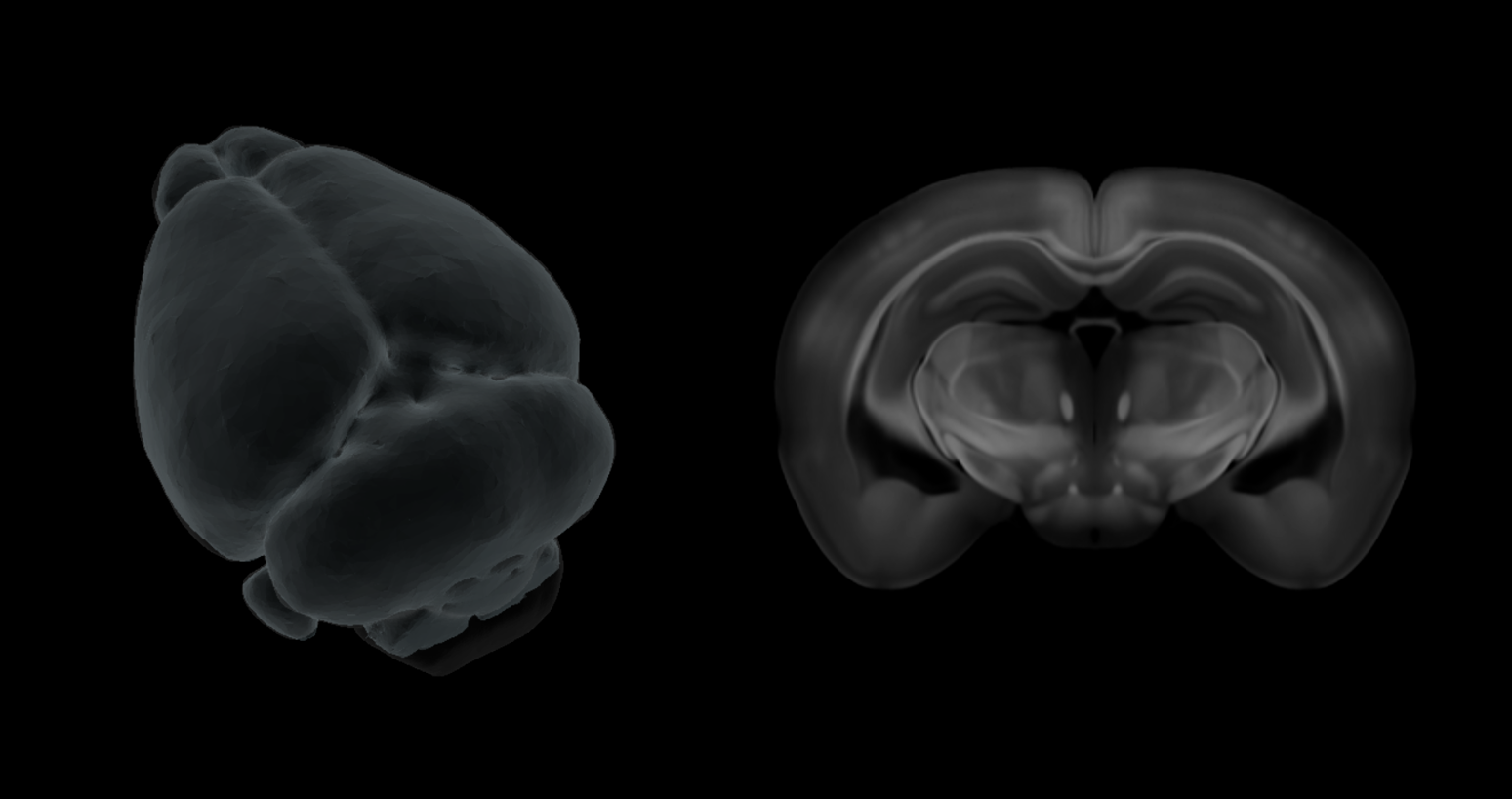
CNS-Voyager™ is an interactive virtual mouse brain that runs entirely in your web browser. No installation. No Python. No command line. You open a URL, and you are looking at a fully navigable 3D brain built on the Perens CCF, a peer-reviewed light sheet reference atlas covering more than 800 anatomical regions (Perens et al., Neuroinformatics).

Everything happens in real time:

Rotate, slice, and zoom. Switch between 3D and 2D views. Cut through the brain in any sagittal or coronal plane. Click any anatomical region to see its name, boundaries, and quantitative data.

Look up stereotactic coordinates. Planning an injection or verifying a surgery site? Place coordinates directly on the 3D brain and check them against the atlas. This alone makes CNS-Voyager™ a daily-use tool for any lab doing stereotactic work, not just imaging specialists.

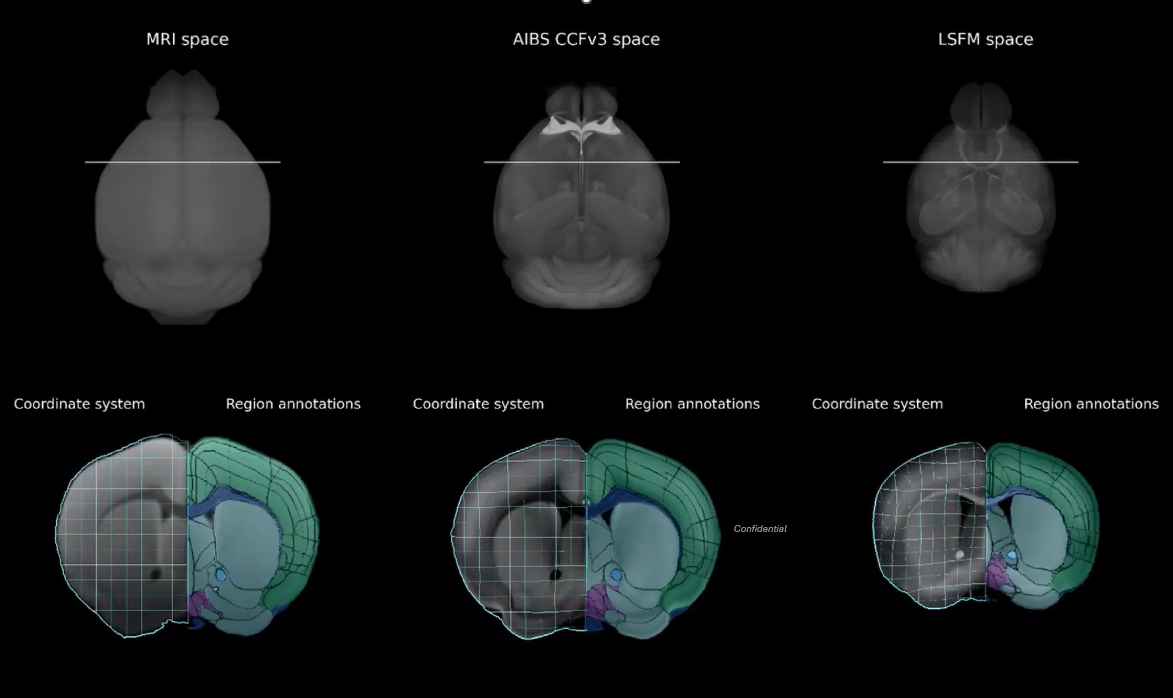
Overlay gene expression for every gene. CNS-Voyager™ integrates the full Allen Brain Cell (ABC) Atlas gene expression maps. Want to know where your receptor of interest is expressed? Look it up and see the expression pattern layered onto the same brain your own data lives in. No other browser-based viewer offers whole-genome expression maps alongside customer data.

Layer in public datasets. Allen Brain Atlas connectivity data, spatial transcriptomics, and published neuronal activity maps are all available as overlays in the same coordinate space. Co-founder Thomas Topilko describes the vision as "almost like a Google Maps of neuroscience," where different data layers sit on top of a shared anatomical reference.

Export publication-ready figures. Generate images, movies, and graphs directly from the platform. No Imaris license. No brainrender scripts. No manual figure-making step.

See it in action

Two recent episodes of Vibraint's Map of the Month series show what this looks like in practice. In the April 2026 episode, a whole-brain tyrosine hydroxylase (TH) map visualizes the dopaminergic system across the entire mouse brain, relevant to Parkinson's research. In the May 2026 episode, co-founder Thomas Topilko walks through a brain-wide c-Fos activation map following semaglutide (the active compound in Ozempic), revealing which brain regions respond to the drug far beyond the hypothalamic circuits most researchers would think to check.

Both datasets demonstrate the core advantage of working in a registered 3D atlas: you see the entire brain, not just the regions you expected to matter.

Who it is for

CNS-Voyager™ is for any neuroscientist who works with mouse brain data and wants to explore it spatially:

  • PhD students and postdocs who need an interactive atlas for hypothesis generation, region lookup, or poster figures
  • PIs who want their lab's published brain maps to be explorable by collaborators and reviewers
  • Drug development teams who need to present whole-brain distribution data to non-specialists without shipping terabytes of raw files

Try CNS-Voyager™

If you have been searching for a brainrender alternative that does not require Python, CNS-Voyager™ is built for exactly that need. Explore the whole mouse brain in 3D, overlay gene expression data for any gene, look up your injection coordinates, and export figures, all from your browser.