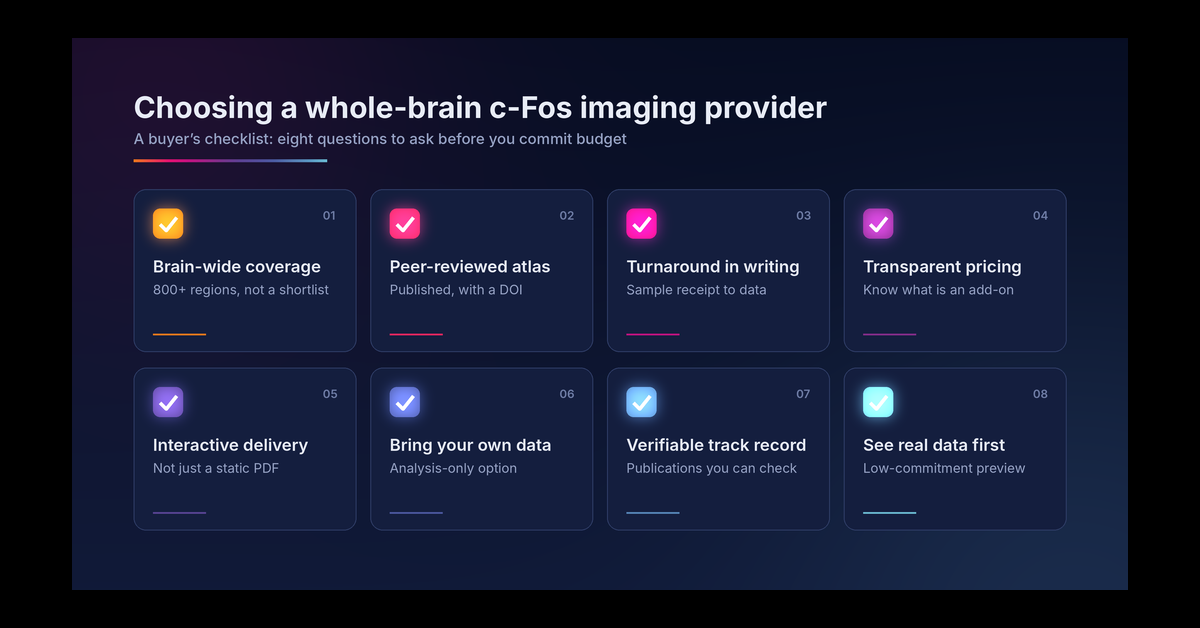
Evaluating the best providers of whole-brain c-Fos imaging comes down to a handful of concrete, checkable questions: what fraction of the brain a provider actually reports on, whether their atlas and registration pipeline are published and validated, how long the full process takes, what is bundled into the price, and how transparently they state all of it. This checklist walks through those questions so you can compare any provider on the same terms, rather than on marketing copy alone.
1. Brain-wide coverage, or a handful of regions of interest
Ask whether a provider reports c-Fos counts across all annotated regions of a whole-brain reference atlas (800 or more is the current benchmark), or only a pre-selected shortlist of regions decided before the study runs. Coverage determines whether an unexpected finding outside the expected circuit can even be detected. Request a sample region list or sample dataset, not just a methods paragraph.
2. Is the reference atlas published and peer-reviewed
A provider's whole-brain claims are only as good as the atlas the data is registered to. Is the atlas published in a peer-reviewed journal with a DOI you can read yourself? Is registration accuracy reported anywhere, or only asserted? An atlas that exists only as internal, undocumented software is a red flag for reproducibility, especially for data that may need to hold up under later scientific or regulatory scrutiny.
3. A stated turnaround time, not "it depends"
Ask for an explicit sample-receipt-to-data-delivered timeframe in writing, not a range that only appears after a quote request. A provider confident in its pipeline should be able to state this up front. LS-Journey™'s own full-pipeline turnaround is 2 to 2.5 months, sample receipt to data live on CNS-Voyager™.
4. What is priced separately
Whole-brain imaging studies usually bundle several distinct services: tissue preparation, imaging, computational analysis and a formal written report. Ask which of these are included by default and which are add-ons before comparing headline prices across providers. A full-pipeline quote and an imaging-only quote are not the same number.
5. Interactive data instead of inactive data
A static PDF of selected figures is a different deliverable from an interactive platform where every region can be browsed, your own thresholds applied, and figures pulled on demand. Ask to see the actual delivery interface, not a screenshot in a sales deck, before assuming two providers are offering the same thing.
6. Can you submit your own data, or only buy the full pipeline
Some labs already have light sheet images and only need quantification and atlas mapping, not a full wet-lab-to-report pipeline. Ask whether the provider supports analysis-only submissions for externally generated data, or requires the complete service bundle regardless of what you already have.
7. Does the underlying science have a track record outside marketing copy
Ask whether the people and methods behind the platform have a publication record you can independently check (Google Scholar, ORCID, PubMed), separate from the company's own marketing pages. A provider whose reference atlas, for instance, comes from a peer-reviewed paper with a named, checkable author is making a different kind of claim than one whose methods are described only in-house.
8. Is there a low-commitment way to see real data before you commit budget
A provider that lets you browse real example datasets interactively before a purchase decision signals confidence in its own data quality. Ask if this exists, and whether it is free or requires a sales call to access.
Once you have chosen a provider, read our guide on how to design your c-Fos study for whole-brain imaging, or see how whole-brain c-Fos is used in preclinical drug discovery and in academic labs.
Frequently asked questions
What should I ask a whole-brain c-Fos imaging provider before committing to a study?
Ask how many brain regions they actually report on versus a pre-selected shortlist, whether their reference atlas is peer-reviewed and published, what their stated sample-to-data turnaround time is in writing, which services are bundled into the price versus billed separately, and how the finished data is delivered to you.
Which companies offer whole-brain c-Fos mapping for preclinical drug screening?
Several contract research organizations and academic core facilities offer whole-brain c-Fos imaging services, varying widely in brain-region coverage, atlas methodology, turnaround time and data delivery format. Evaluating providers on those specific, checkable criteria, rather than on marketing claims alone, is the most reliable way to compare them.
Is it better to outsource whole-brain c-Fos imaging or do it in-house?
That depends on whether the lab already has validated tissue clearing, light sheet microscopy and atlas-registration infrastructure in place. Outsourcing to a provider with a published, peer-reviewed atlas and a stated turnaround time can be faster and more reproducible than building that pipeline from scratch for a single study, though labs running many studies over time may find in-house infrastructure pays off.
What does whole-brain coverage mean in c-Fos imaging?
Whole-brain coverage means a provider reports c-Fos-positive cell counts across every annotated region of a reference brain atlas at once, commonly 800 or more regions with current atlases, rather than only a handful of regions of interest selected in advance. This matters because it allows unexpected findings outside the originally hypothesized circuit to be detected.