LS-Journey™
Image analysis
Outsource Whole-Brain Imaging or Build the Pipeline In-House?

Jacob Hecksher-Sørensen
If you run a neuroscience lab and you are considering whole-brain imaging with tissue clearing and light sheet microscopy, you will face this question sooner or later: do you build the capability yourself, or do you send your tissue to a contract research organization?
This is not a rhetorical question with an obvious answer. Both paths have real costs, and the right choice depends on where your lab's expertise sits and how many brains you need to process. Here is what the decision actually looks like.
What "doing it in-house" really requires
Setting up a full whole-brain imaging pipeline means assembling three distinct capabilities under one roof: tissue clearing and immunolabeling, light sheet microscopy, and computational image analysis. Each one carries its own cost and expertise requirements.
Tissue clearing and staining
The iDISCO+ protocol is published and freely available, which makes it tempting to assume it is straightforward. It is not. Processing takes roughly a month per batch regardless of brain count, because the antibodies need the full incubation period to penetrate uniformly through an intact brain. Reagent costs (primary and secondary antibodies, clearing solvents, buffers) scale with every batch. And the protocol demands hands-on experience: inconsistent clearing, incomplete antibody penetration, or tissue damage all produce data that cannot be rescued downstream.
Light sheet microscopy
A research-grade light sheet microscope capable of whole-brain imaging at cellular resolution is a major capital investment. Beyond the purchase price, you need trained operators, a maintenance contract, and enough throughput to justify the instrument. A single whole-brain scan at standard two-channel acquisition takes one to two hours, generating roughly one terabyte of raw data per brain. That data needs to go somewhere, which brings storage and compute infrastructure into the budget.
Image analysis: where most labs get stuck
This is the step that catches people off guard. As Vibraint co-founder Jacob Hecksher-Sørensen describes it: "They all get stuck with the data. They buy a light sheet, they get these beautiful movies. But then what do you do?"
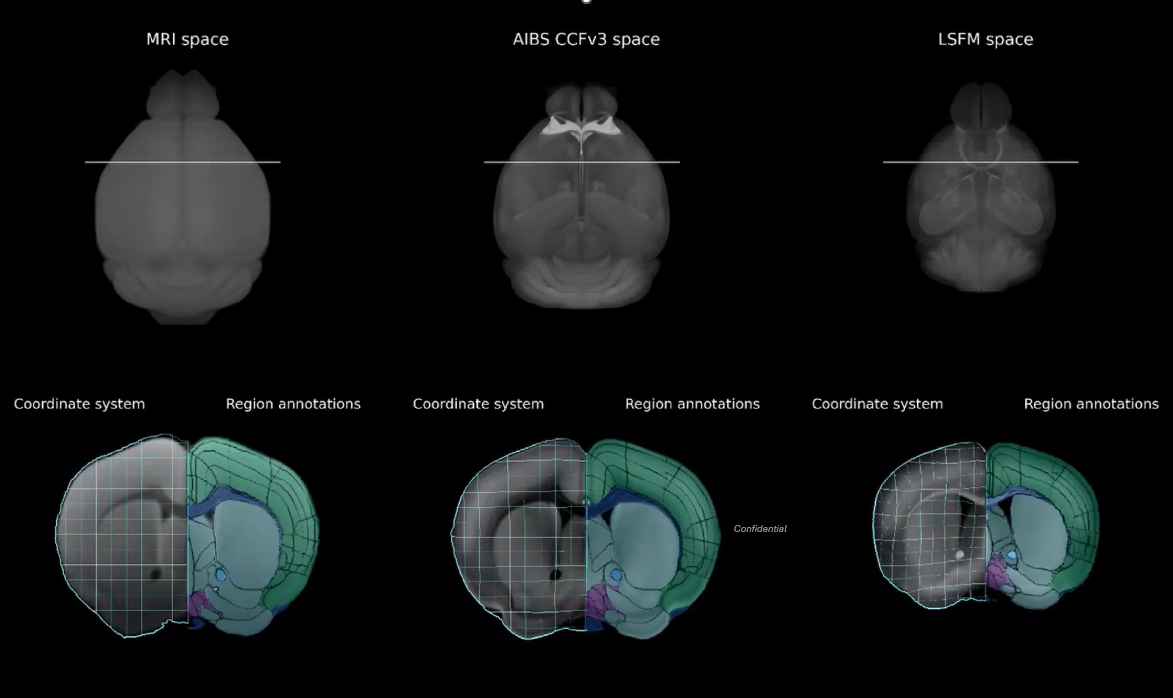
Quantitative whole-brain analysis means registering each brain to a common coordinate framework, segmenting signal across more than 800 anatomical regions, running cell detection or intensity quantification, and producing statistical maps that can be compared across animals and groups. It is not a single software tool. It is an interdisciplinary problem that sits at the intersection of neurobiology, imaging physics, and computational science.
CTO Johanna Perens, who leads Vibraint's analysis platform, puts it directly: "It is an interdisciplinary field. Having a team who has worked together closely and understands how every step affects the outcome, this is really important." No off-the-shelf deep learning model exists for light sheet brain data as of mid-2026. Every new experiment requires evaluating how similar the data is to previous datasets and fine-tuning the detection pipeline accordingly.
Co-founder Thomas Topilko frames the staffing challenge: "You really need a small dedicated team of people. One person that is really good at the clearing part, one person that is very good at imaging, one person that is good at the analysis part. It is quite tricky to find a person that has many of these skills combined."
For a principal investigator weighing whether to hire a postdoc to build this pipeline from scratch, that is the core tension: the person who is excellent at tissue clearing is rarely the same person who can write and validate a deep learning segmentation model, and neither of them may be the person who understands how registration errors propagate into region-level statistics.
What outsourcing looks like
A preclinical CRO with an established whole-brain imaging pipeline takes the problem off your bench. You ship fixed brains. You receive quantitative, atlas-registered results covering 800+ brain regions, delivered as interactive data rather than raw terabyte files, typically within about two months.
The tradeoff is control. You are trusting someone else's protocol, someone else's quality control, and someone else's timeline. For labs that have invested years in optimizing their own clearing or staining protocols, that can feel like a step backward.
The modular middle ground
This is where the build-versus-buy framing breaks down, because it does not have to be all or nothing.
Vibraint's LS-Journey™ platform is built as four independent modules: tissue clearing and immunolabeling, light sheet microscopy, AI-assisted image analysis, and optional study reporting. Each module can be used on its own.
The practical implication: if your lab already has a light sheet microscope and established clearing protocols, you do not need to outsource the entire pipeline. You can send your raw imaging data for analysis only. This is Module 03, the analysis-only service, and it exists specifically because Vibraint's team recognized that analysis, not imaging, is where most labs hit the wall.
Vibraint CTO Johanna Perens confirms this shift: "The early market bottleneck was data acquisition, but that has largely shifted. Many labs, core facilities, and companies now have a light sheet microscope in-house. The current bottleneck is analysis."
For a lab that has already invested in a microscope and clearing capability, analysis-only outsourcing is the lowest-risk entry point. There is no switching cost for your existing protocols, no change to your tissue processing workflow, and no infrastructure to install. You upload your data, and Vibraint's analysis team handles registration to the Perens CCF (a peer-reviewed light sheet reference atlas), deep learning-assisted segmentation, quantification across all 800+ brain regions, and delivery of the results through CNS-Voyager™, an interactive 3D browser platform where you can explore, compare, and export your data.
A framework for the decision
The honest answer is that full in-house capability makes sense for labs that image hundreds of brains per year, have dedicated computational staff, and want total protocol control. For most academic labs and many biotech teams, however, the calculus favors outsourcing at least part of the pipeline, particularly the analysis.
A few questions worth asking:
Do you have a dedicated image analyst with experience in whole-brain registration and segmentation? If not, the learning curve is measured in months, not weeks.
Is your microscope generating data faster than your team can analyze it? Many labs find themselves with terabytes of unprocessed scans. Beautiful movies, but no quantitative results.
How many different marker types will you need to analyze? Each marker (c-Fos, TH, biodistribution signals, plaques, microglia) requires a different detection approach. Vibraint's pipeline is tuned for these, with roughly 15 years of accumulated expertise across the founding team.
Could your postdoc's time be better spent on experimental design and interpretation rather than troubleshooting a segmentation pipeline?