
c-Fos
whole-brain imaging
Glp-1
Which Brain Receptors Do Next-Generation Obesity Drugs Target?

Jacob Hecksher-Sørensen
Last updated: October 2026
Next-generation obesity drugs target six receptors that act on appetite and energy balance: the GLP-1 receptor (Glp1r), the GIP receptor (Gipr), the glucagon receptor (Gcgr), the amylin receptor (built on the calcitonin receptor, Calcr), the melanocortin 4 receptor (Mc4r) and the neuropeptide Y2 receptor (Npy2r). Three further receptors, Gfral (GDF15), Lepr (leptin) and Klb (β-Klotho, the FGF21 co-receptor), were pursued as obesity targets earlier. Monotherapy programs against them have been discontinued for obesity, but the targets have not gone away: they remain of interest as partners in combination and polyagonist therapies, where they could add to the effect of incretin-based drugs.
Most of these drugs are designed to hit more than one receptor at once. Tirzepatide combines GLP-1 and GIP receptor agonism, CagriSema and amycretin combine GLP-1 and amylin signaling, and retatrutide adds the glucagon receptor to make a triple agonist. The table below groups the current pipeline by receptor, so a multi-receptor drug appears in every row it acts on.
Obesity drugs grouped by target receptor
| Receptor (gene) | Endogenous ligand | Drugs targeting the receptor |
|---|---|---|
| Glp1r, selective | GLP-1 | Semaglutide (s.c. and oral), berobenatide, ecnoglutide, visepegenatide, bofanglutide, orforglipron, aleniglipron, elecoglipron, conveglipron, CT-996, TERN-601, HS-10535, RGT-075, ASC30 |
| Glp1r, within multi-receptor drugs | GLP-1 | Tirzepatide, enicepatide, VK2735, poterepatide, HRS9531, HS-20094, MBX 4291, MariTide, survodutide, mazdutide, pemvidutide², AZD9550, efinopegdutide², DA-1726, retatrutide, UBT251, HM15275, amycretin, CagriSema |
| Gipr (agonism) | GIP | Tirzepatide, enicepatide, VK2735, poterepatide, HRS9531, HS-20094, MBX 4291, retatrutide, UBT251, HM15275 |
| Gipr (antagonism) | GIP | MariTide (maridebart cafraglutide) |
| Gcgr | Glucagon | Survodutide, mazdutide, pemvidutide², AZD9550, efinopegdutide², DA-1726, retatrutide, UBT251, HM15275 |
| Calcr (amylin receptor, with RAMP1/3) | Amylin, calcitonin | Cagrilintide (in CagriSema), amycretin, eloralintide, petrelintide, AZD6234, ABBV-295, PF-08653945 (MET-233i), ACCG-2671 (oral) |
| Mc4r | α-MSH (antagonized by AgRP) | Setmelanotide, bivamelagon (oral), RM-718 |
| Npy2r (Y2) | PYY, NPY | PYY1875 (NNC0165-1875) |
| Gfral | GDF15 | LY3463251¹, MBL949¹ |
| Lepr | Leptin | Metreleptin³ |
| Klb (β-Klotho, FGF21 co-receptor) | FGF21 | LY2405319¹, PF-05231023¹, efruxifermin², pegozafermin², efimosfermin (BOS-580)² |
¹ Discontinued for obesity indications.
² Primarily in development for MASH (metabolic dysfunction-associated steatohepatitis).
³ Approved for lipodystrophy; discontinued for obesity indications.
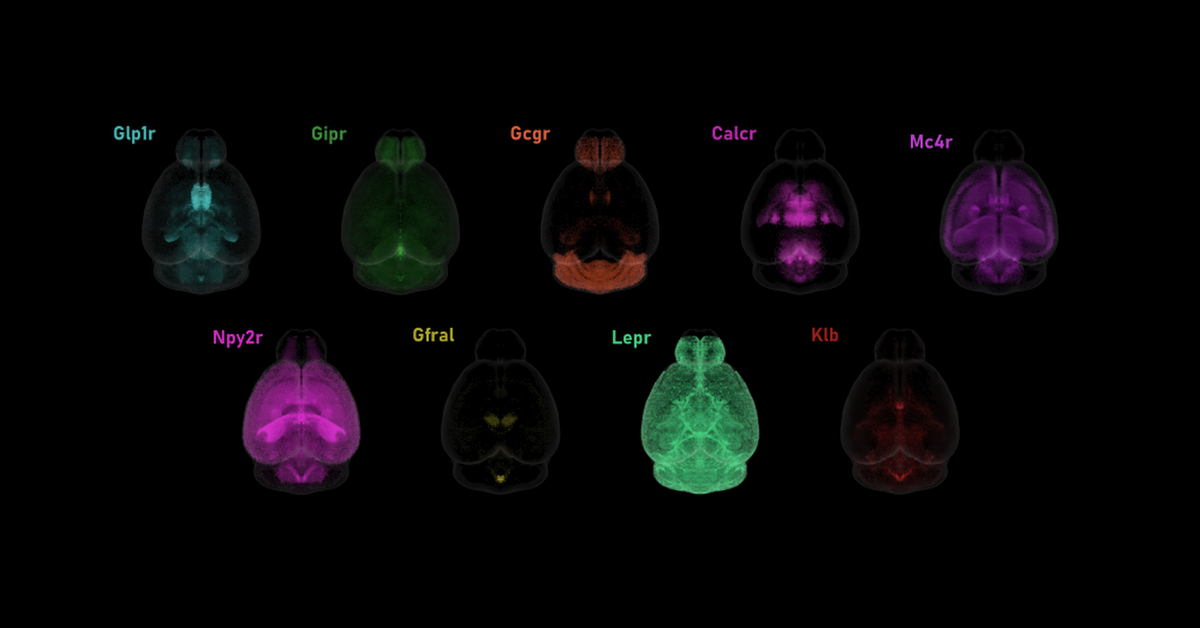
Gene names follow mouse nomenclature (for example Glp1r), matching how the receptors are mapped in preclinical whole-brain studies. The human receptor names are GLP1R, GIPR, GCGR, CALCR, MC4R, NPY2R, GFRAL, LEPR and KLB.
What each receptor does in the brain
GLP-1 receptor (Glp1r). The anchor target of the field. Glp1r is expressed in the hindbrain (area postrema and nucleus of the solitary tract) and the hypothalamus. Peripherally dosed GLP-1 receptor agonists reach brain regions close to the circumventricular organs, including the arcuate nucleus, as shown for liraglutide by Secher et al. (2014).
GIP receptor (Gipr). Both GIPR agonism (tirzepatide, retatrutide) and GIPR antagonism (MariTide) add weight loss on top of GLP-1 receptor agonism. How opposite pharmacology at the same receptor produces a similar outcome remains unresolved, and comparing brain-wide activation patterns of the two approaches side by side is one direct way to test it.
Glucagon receptor (Gcgr). Glucagon receptor agonism is added mainly to raise energy expenditure and act on the liver. Gcgr expression in the brain is sparse compared with the incretin receptors, which makes it a useful contrast when interpreting the central effects of dual and triple agonists.
Amylin receptor (Calcr with RAMP1 or RAMP3). Amylin receptors are formed when the calcitonin receptor pairs with a receptor activity-modifying protein. The area postrema is a primary site of action. Amylin analogues such as cagrilintide, eloralintide and petrelintide, and the GLP-1/amylin co-agonist amycretin, are the fastest-growing receptor class in the pipeline.
Melanocortin 4 receptor (Mc4r). Mc4r sits downstream of leptin and the arcuate nucleus POMC and AgRP neurons, with key expression in the paraventricular hypothalamus. Setmelanotide is approved for specific genetic and hypothalamic forms of obesity, and its whole-brain c-Fos signature overlaps with those of other weight-lowering drugs, including semaglutide, in the dorsal vagal complex and hypothalamus (Hansen, Perens et al., 2021).
Neuropeptide Y2 receptor (Npy2r). PYY acts at Y2 receptors on arcuate NPY/AgRP neurons to reduce food intake. Clinical development of PYY analogues has been limited by nausea.
GDF15 receptor (Gfral). Gfral expression is restricted to the area postrema and nucleus of the solitary tract. GDF15 analogues produced little weight loss in clinical trials and were discontinued for obesity.
Leptin receptor (Lepr). Leptin replacement works in leptin deficiency and lipodystrophy, but leptin resistance limits its effect in common obesity.
β-Klotho (Klb). β-Klotho is the obligate co-receptor for FGF21. Early FGF21 analogues were discontinued for obesity, and the current FGF21 drugs are in development for MASH.
How to test whether an obesity drug is working in the brain
A receptor expression map shows where a drug could act. It does not show where the drug actually goes, or which neurons respond. In preclinical studies those are two separate measurements, and both can be made across the whole mouse brain rather than in a few preselected regions.
1. Biodistribution: where does the drug go?
Whole-brain biodistribution imaging tracks a labeled version of the drug (typically fluorescent) after peripheral dosing, then maps its signal across the cleared brain with light sheet microscopy. For peptide drugs this answers the blood-brain barrier question directly: most incretin and amylin analogues reach the circumventricular organs and the regions next to them, such as the area postrema and the arcuate nucleus, rather than the whole brain. Secher et al. (2014) used this approach to show that liraglutide accesses the arcuate nucleus and that this region mediates its weight-lowering effect. Read more in Where does your CNS drug actually go in the brain? and on our whole-brain biodistribution and BBB passage page.
2. c-Fos mapping: which neurons respond?
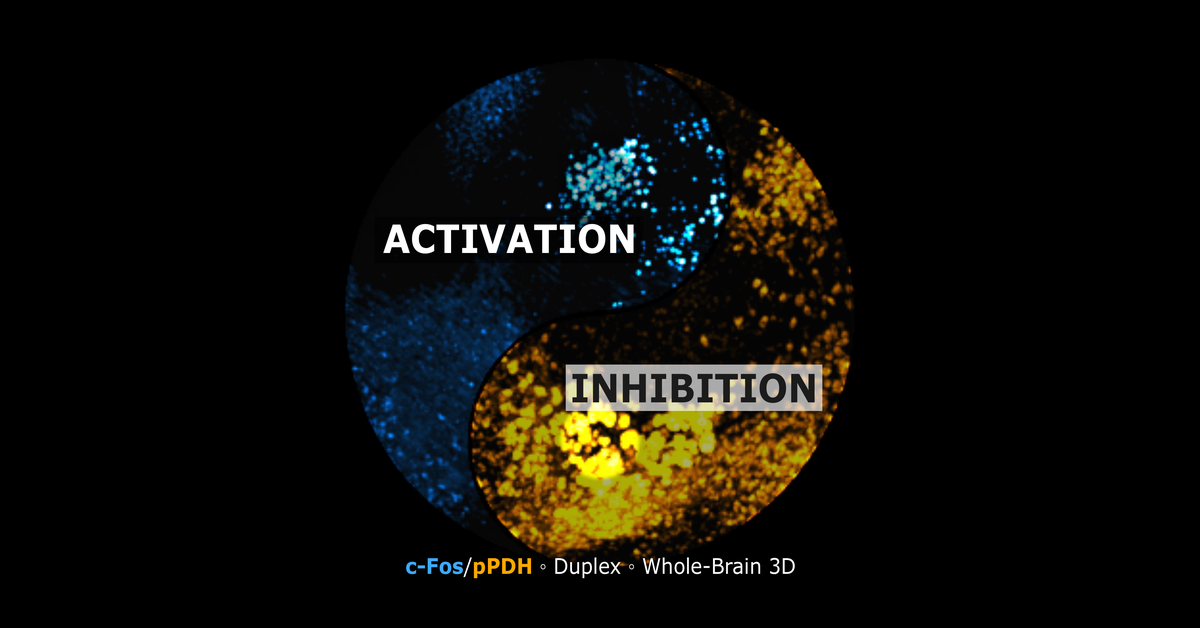
c-Fos is an immediate early gene expressed in neurons shortly after they are activated. Counting c-Fos-positive cells across 800+ brain regions after dosing shows the full network a drug engages, including regions the drug never reaches itself but that receive input from the ones it does. Our whole-brain c-Fos map of semaglutide is a worked example, from hypothalamic appetite circuits to brainstem regions linked to nausea. Hansen, Perens et al. (2021), a study led by Vibraint founders Johanna Perens and Jacob Hecksher-Sørensen, used the same approach to compare six weight-lowering drug classes, including semaglutide (Glp1r) and setmelanotide (Mc4r), across 308 brain regions. Despite their different receptor targets, the drugs produced overlapping c-Fos responses in the dorsal vagal complex and hypothalamus, with additional activation of limbic structures and the dopaminergic system. For the method itself, see What is whole-brain c-Fos mapping?, how to design a c-Fos study (dose, timing and group sizes) and how to quantify c-Fos across the whole mouse brain. Our c-Fos for preclinical drug development page covers the service side.
3. pPDH: which neurons are inhibited?
c-Fos captures activation but not inhibition. Many appetite circuits work by silencing neurons, for example the AgRP neurons in the arcuate nucleus. Phosphorylated pyruvate dehydrogenase (pPDH) rises when neuronal firing drops and can be mapped brain-wide alongside c-Fos. See What is pPDH? A marker for neuronal inhibition.
Putting the layers together
The three measurements become most informative when they sit in the same reference space as the receptor maps. A region that expresses the target receptor, contains the drug and shows c-Fos is a candidate direct site of action. A region with c-Fos but no drug signal is more likely a downstream node in the circuit. Separating the two is a direct way to work out which effects of a dual or triple agonist come from which receptor, and is worth running side by side for a mono-agonist and a multi-agonist at matched exposure.
If you are comparing providers for this kind of study, our buyer's checklist for whole-brain c-Fos imaging lists the questions to ask. LS-Journey™ covers labeling, light sheet imaging and analysis, as a full pipeline or as separate modules.
Mapping obesity drug receptors across the whole mouse brain
All nine receptors in the table are mapped in CNS-Voyager™, Vibraint's browser-based 3D mouse brain atlas, on the same Perens light sheet reference brain used for whole-brain c-Fos and drug biodistribution data. That makes it possible to overlay where a receptor is expressed with where a drug goes and which regions it activates, without writing code.
Which of these receptors account for the central effects of multi-receptor drugs, as opposed to their peripheral metabolic effects, is still an open question. Comparing receptor expression maps with whole-brain c-Fos and biodistribution data from the same reference space is a direct way to address it.
Frequently asked questions
Which receptors do next-generation obesity drugs target?
Next-generation obesity drugs mainly target the GLP-1 receptor, the GIP receptor, the glucagon receptor, the amylin receptor (calcitonin receptor with RAMP1 or RAMP3), the melanocortin 4 receptor and the neuropeptide Y2 receptor. Many newer drugs combine two or three of these in one molecule.
What is the difference between a dual and a triple agonist?
A dual agonist activates two receptors, for example tirzepatide (GLP-1 and GIP receptors) or survodutide (GLP-1 and glucagon receptors). A triple agonist activates three, for example retatrutide (GLP-1, GIP and glucagon receptors).
Which obesity drugs target the amylin receptor?
Amylin receptor agonists include cagrilintide (part of CagriSema), amycretin, eloralintide, petrelintide, AZD6234, ABBV-295 and PF-08653945. The amylin receptor is formed by the calcitonin receptor (CALCR) together with RAMP1 or RAMP3.
Where in the brain do GLP-1 drugs act?
GLP-1 receptors are expressed in the hindbrain (area postrema and nucleus of the solitary tract) and in the hypothalamus, including the arcuate nucleus. Peripherally dosed GLP-1 drugs reach regions near the circumventricular organs.
How do you test whether an obesity drug acts in the brain?
In preclinical studies, whole-brain biodistribution imaging shows which brain regions a labeled drug reaches, and whole-brain c-Fos mapping shows which neurons are activated after dosing. pPDH mapping adds neurons that are inhibited. Combined with receptor expression maps in the same atlas space, these separate direct sites of action from downstream circuit effects.
Why did GDF15, leptin and FGF21 fail as stand-alone obesity drugs?
As monotherapies, GDF15 analogues produced little weight loss in clinical trials, leptin resistance limits leptin therapy in common obesity, and early FGF21 analogues were discontinued for obesity. The three pathways remain of interest as partners in combination and polyagonist therapies, and FGF21 analogues are also being developed for MASH.
References
Hansen HH, Perens J, Roostalu U, et al., Hecksher-Sørensen J. Whole-brain activation signatures of weight-lowering drugs. Mol Metab. 2021;47:101171. doi:10.1016/j.molmet.2021.101171
Secher A, Jelsing J, Baquero AF, et al., Hecksher-Sørensen J, et al. The arcuate nucleus mediates GLP-1 receptor agonist liraglutide-dependent weight loss. J Clin Invest. 2014;124(10):4473-4488. doi:10.1172/JCI75276